

When people think about divorce, they often think first about the legal process – lawyers, property settlements, parenting arrangements, and the formal ending of a marriage.
But very quickly, other questions can arise:
How am I going to financially survive?
Where will I live?
What will happen to my family and relationships?
What will my life look like now?
Divorce is much more than a legal process.
It is a significant life transition that can affect your relationships, friendships, family, finances, home, emotions, and plans for the future – often all at the same time.
This is one of the reasons divorce can feel so overwhelming. You aren’t dealing with one change. You may be dealing with many interconnected changes while also being expected to process information, make important decisions, and plan for a future that may still feel uncertain.
At Lifeology Family, we look at divorce through two interconnected lenses: the three phases – Pre-Divorce/Separation, During Divorce/Restructuring, and Post-Divorce/Rebuilding – and four S.A.F.E. components: Social, Attorney, Financial, and Emotional.
These components can overlap, interact and reappear at different points throughout the divorce journey.
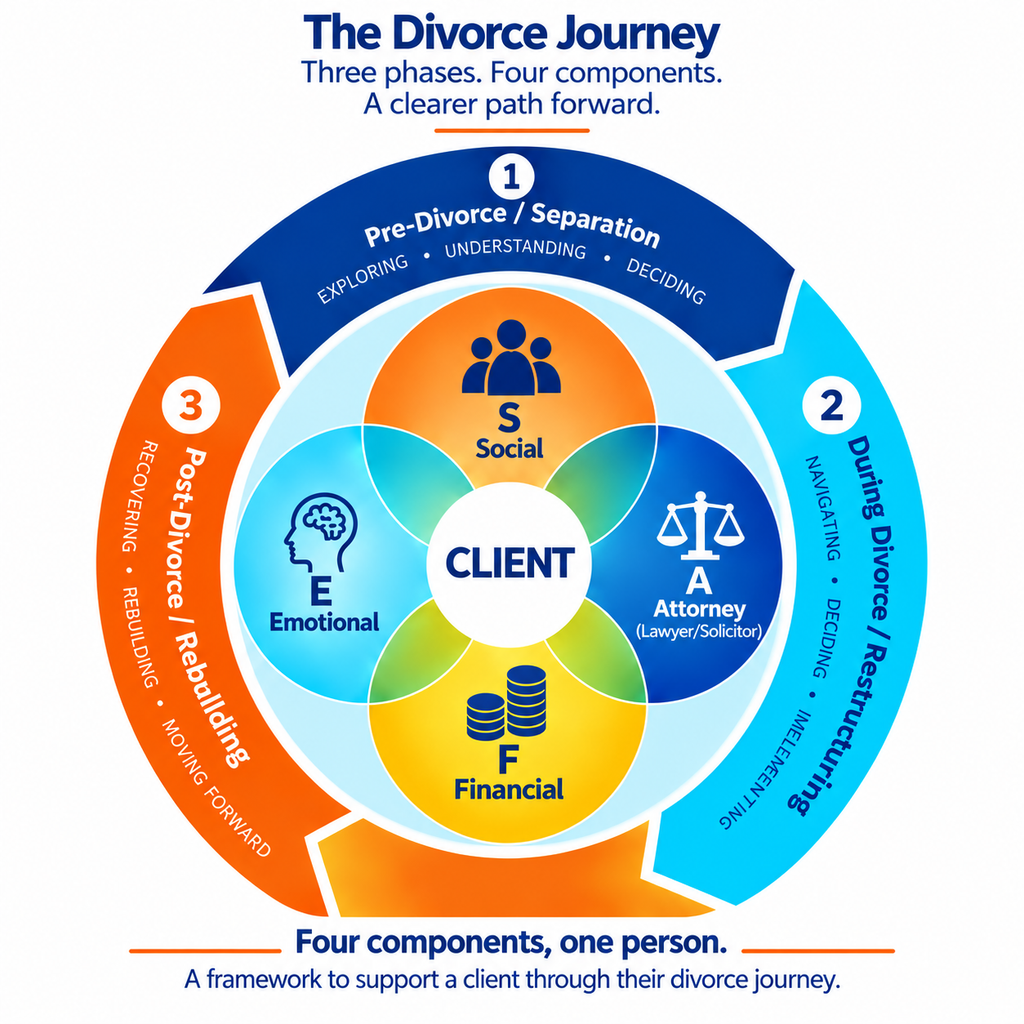
The diagram illustrates an important distinction: where you are in your divorce journey and what you are dealing with. These are two very different things.
Understanding both can help you answer two important questions:
Where am I?
Where am I stuck?
Divorce is a journey, not a single event
While every person’s experience is different, we can think about the divorce journey as having three broad phases.
Phase 1 – Pre-Divorce / Separation
This is often the period in which someone is asking:
“Is separation or divorce right for me and my family?”
There may be uncertainty about whether the relationship can continue, what separation would mean for children, finances and family life, and what life might look like if the relationship ends.
For some people, this is a time of gathering information and trying to understand their options before making significant decisions.
Phase 2 – During Divorce / Restructuring
Once the decision to separate or divorce has been made, the practical reality can become much more immediate.
There may be legal decisions to make, financial information to gather, property and housing questions to
address, parenting arrangements to consider and difficult conversations to navigate.
At the same time, the family itself is restructuring.
This can be one of the most demanding periods of the divorce journey. At a time when emotions may be intense and life uncertain, you may simultaneously be required to process complex information, make significant legal and financial decisions, gather documentation, navigate conflict, and make choices that can shape your life and your family’s future for years to come.
Phase 3 – Post-Divorce / Rebuilding
The formal legal process may eventually finish, but the human transition doesn’t necessarily finish with it.
There may still be changes to relationships, parenting, friendships, finances, identity, routines, work, and future plans.
The questions can begin to change from:
“How am I going to get through this?”
to:
“What do I want my life to look like now?”
Across all three phases, the different components of S.A.F.E. can appear, disappear and reappear.
The four components of divorce: S.A.F.E.
S.A.F.E. describes four interconnected components of divorce:
Social. Attorney. Financial. Emotional.
Importantly, these are not four consecutive stages. They can happen at the same time, affect one another and become significant again at different points in your divorce journey.
S – Social
Divorce can change your social world.
Friendships may change or be lost. Friends and family members may feel pressured to take sides. Relationships with extended family can shift. Social routines and networks may change and, where children are involved, family and parenting relationships may need to be restructured.
You may also find yourself reconsidering where you belong and which relationships you want to take with you into the next stage of your life.
These social consequences can sometimes be overlooked when attention is focused on the legal and financial aspects of separation, but they are part of divorce too.
A – Attorney (Lawyer/Solicitor)
This is the Legal Component of divorce.
Your lawyer or solicitor is the appropriate professional to advise you about your legal position, rights, responsibilities, options and the legal processes relevant to your circumstances.
Legal advice belongs with your legal professional.
That boundary matters.
F – Financial
Your financial life may change significantly through separation and divorce.
Property, income, budgets, housing, accounting, financial planning and the restructuring of your financial circumstances may all need consideration. So too might questions about your future earning capacity – whether you need to return to work, increase your working hours, update your skills or qualifications, or consider a career change.
Some questions will require specialist financial, accounting or other professional expertise. Financial advice should come from an appropriately qualified financial professional.
But the Financial component isn’t only about obtaining advice. There can also be considerable practical work involved in gathering information, locating records, understanding what has been requested and getting organised so you can work effectively with the professionals advising you.
E – Emotional
Then there is the Emotional Component of divorce.
Separation can involve grief, anger, fear, uncertainty, confusion, sadness, relief, guilt, shame, blame and overwhelm – sometimes several conflicting emotions at once.
There may be the loss of the relationship itself, but also the loss of expectations about what your family, home, financial security, or future was supposed to look like.
And there is often uncertainty:
Where will I live? Will I be financially OK? What will happen with my children? What relationships will I lose? What will my life look like when this is over?
The Emotional component can be thought of as the golden thread running through the entire divorce process because it can weave itself through every other part of S.A.F.E.
How you are feeling can influence how you respond to changes in friendships and family relationships, how you communicate with your former partner, how you engage with your lawyer or solicitor, how openly and clearly you provide information, and how you approach conversations and decisions with your financial professionals.
When the emotional load becomes overwhelming, it can sometimes make it harder to step out of the emotional story of divorce and attend to what the practical process requires.
When the four components become tangled
Imagine your solicitor has asked you to gather information before your next appointment.
On the surface, that may look like a straightforward legal or practical task. But:
- You’re worried about what it means financially
- You’re exhausted or overwhelmed
- Conversations with your former partner are difficult
- You’re unsure where to find the information
Suddenly, something that appears to belong in one part of S.A.F.E. is being affected by several others.
Research into acute stress indicates that stress can affect cognitive processes involved in decision-making. A 2024 systematic review of 44 studies found evidence that acute stress can impair processes required for decision-making, although the effects are complex and vary according to the processes involved.
Research into working memory similarly suggests that acute stress can affect working-memory performance, with the effects influenced by factors including timing.
In everyday terms, when you’re under significant stress, processing information, holding multiple pieces of information in your mind and making complex decisions may become more difficult.
That doesn’t mean someone going through divorce cannot make sound decisions. It means we should recognise the circumstances in which they are being asked to make them.
And this is why simply knowing what you need to do isn’t always enough.
Sometimes you first need to understand:
What is getting in the way of me doing it?
Where are you – and where are you stuck?
When we work with someone experiencing separation or divorce, two useful questions are:
Where are you in the divorce journey?
Where are you stuck?
Are you in the Pre-Divorce/Separation phase and struggling to decide what you want?
Are you During Divorce/Restructuring and overwhelmed by the information, tasks, and decisions in front of you?
Has the formal divorce process finished, but you’re struggling to rebuild your life afterwards?
Then look through the S.A.F.E. lens.
Is the issue primarily Social?
Does it belong with your Attorney – your lawyer or solicitor?
Is it Financial?
Is it Emotional?
Or are several components interacting?
Identifying where you are stuck doesn’t necessarily give you the answer. But it can help identify what kind of help you need next – and who is best placed to provide it.
From the emotional story of divorce to the practical business of divorce
One of the ways we describe this work at Lifeology Family is helping someone move:
From the emotional story of divorce → towards the practical business of divorce
The aim isn’t to take emotion out of the divorce process.
Divorce is emotional.
But alongside managing the emotional impact, there are also practical things that may need your attention.
That might mean:
- Organising yourself and gathering information
- Formulating the questions you need answered
- Managing a difficult conversation
- Simply taking the next practical step
- Finding documents and preparing for meetings
- Speaking with the appropriate professional
- Considering your options and making decisions
This movement isn’t necessarily linear.
You may feel clear and organised one week and find yourself pulled back into the emotional story the next because something has changed Socially, Legally, Financially or Emotionally.
The aim isn’t to stop feeling. It is to help you function while you are feeling – and to keep moving through the practical business of your divorce.
Who is in your Divorce Tribe?
Divorce involves different areas of expertise. It is unreasonable to expect one professional to provide all of them.
We describe the professionals who support you through the different aspects of your separation and divorce as your Divorce Tribe.
Depending on your circumstances, that Tribe might include a:
- Divorce Coach
- Financial adviser or accountant
- Lawyer or solicitor
- Real estate professional
Other professionals may join your Tribe when needed – perhaps a child psychologist, family therapist, mortgage broker or another specialist relevant to your circumstances.
Not everyone needs the same Divorce Tribe – your Divorce Tribe should reflect your divorce.
The important principle is:
The right professional for the right issue at the right time.
Your Divorce Coach is also a member of that Tribe.
Where does a Divorce Coach fit?
One of my roles as a Divorce Coach is to help you work out where you are, where you’re stuck, and what you need next.
Sometimes that work is emotional or interpersonal. Sometimes it is about helping you focus on the information, decisions, and actions that are within your control. And sometimes it is very practical.
If you have a legal question, I don’t provide the legal answer. But I can help you clarify what you don’t understand, organise your thinking, formulate the questions you want to ask, identify information you may need to locate, and prepare for your conversation with your lawyer or solicitor.
The same principle applies to financial matters.
I don’t provide financial advice. But suppose your accountant or financial adviser asks you to prepare information about your monthly expenses.
We can work through what information has been requested, whether you know where to find it, what records you already have and what you still need to locate.
That might involve identifying where you can find records relating to health, car, life or home insurance, household expenses and other regular commitments, then helping you organise what you’ve gathered so you’re better prepared for your next conversation with your financial professional.
The distinction is important.
The Divorce Coach helps you prepare, organise, clarify, manage the emotional and interpersonal aspects within their expertise, and follow through – so you can engage with the appropriate members of your Divorce Tribe.
My work as a Divorce Coach is informed by my professional background as a Registered Psychologist and ICF Professional Certified Coach, together with my specialist training and certification in Divorce Coaching and Dispute Resolution Coaching, including further specialist training in Amicable, Holistic and High Conflict Divorce Coaching.
This allows me to work with the person experiencing the divorce while respecting the expertise and professional boundaries of the other professionals around them.
Right professional. Right issue. Right time.
Divorce can feel overwhelming because so many things may be changing at once.
You may not always know what to deal with first, what you can manage yourself, or when you need support from someone else.
The S.A.F.E. framework and the three phases of divorce provide a way of making sense of what can otherwise feel tangled.
They can help you step back and ask:
Where am I?
Where am I stuck?
What do I need next?
And importantly:
Who is the right person to help me with it?
Because sometimes the first step towards making divorce feel more manageable isn’t having all the answers.
Evidence and further reading
- van Herk L, Schilder FPM, de Weijer AD, Bruinsma B, Geuze E. (2024). Heightened SAM- and HPA-axis activity during
acute stress impairs decision-making: A systematic review on underlying neuropharmacological mechanisms. Neurobiology
of Stress, 31, 100659.
This systematic review included 44 studies examining acute stress and processes involved in decision-making.
Open-access article: https://pmc.ncbi.nlm.nih.gov/articles/PMC11277380/ - Geißler CF, Friehs MA, Frings C, Domes G. (2023). Time-dependent effects of acute stress on working memory performance: A systematic review and hypothesis. Psychoneuroendocrinology, 148, 105998.
This systematic review examined the relationship between acute stress and working-memory performance and found that the
effects are influenced by factors including timing.
PubMed record: https://pubmed.ncbi.nlm.nih.gov/36493660/